About Me

My photo
Adalbert is a forum for me, to post ephemera, photography, poetry, occasional travel notes, and various spontaneous motions. Cover photo: Parsonage where my great-grandfather spent his early years. Taken near Liegnitz, Silesia, ca. 1870. The "xothique" portion of the web address is a nod to Clark Ashton Smith's fictional continent of Zothique.
Showing posts with label Beat Generation. Show all posts

Sunday, November 8, 2020

Meeting with Allen Ginsberg, April 12, 1985, Boulder, Colorado

 A (lightly edited) journal entry of mine, covering a meeting with Allen Ginsberg, at the Boulder Bookstore in Boulder, Colorado, on April 12, 1985. 

Written on April 15, 1985 (Boulder, Colorado). Monday. Saturday (April 12), R. arrived. We stayed in the Trident Coffee House for a while, then sat out on the courthouse lawn and snapped pictures of each other. At 5:30, we went to the Boulder Bookstore and met (Allen) Ginsberg; talked to him around ten or 15 minutes, interrupted only by people who wanted their books signed. We told him a little about Oddities, our philosophies (?) and so on. In the books which he signed he stamped two Tibetan symbols, of which he explained the meanings. One, I believe, indicated a Boddhisatva. Ginsberg asked Roman what kind of camera he had; R. explained it was an 'idiot' camera. Upon which we saw that Allen had a similar one himself! He asked us to buy film for him; we agreed, but were unsure of a near location. Another guy bought the film in the end. 

G. snapped a picture of me, also one of a man holding a Blake/Dante book. I was grinning idiotically. We finally left through nervousness and because larger crowds were gathering about the poet. He seemed friendly and courteous as well as cryptic. Also I saw a reading he gave at the Naropa Institute on Wednesday. Quite an exuberant reader. Yesterday we saw The Wicker Man... 
-- JF 


Saturday, June 1, 2019

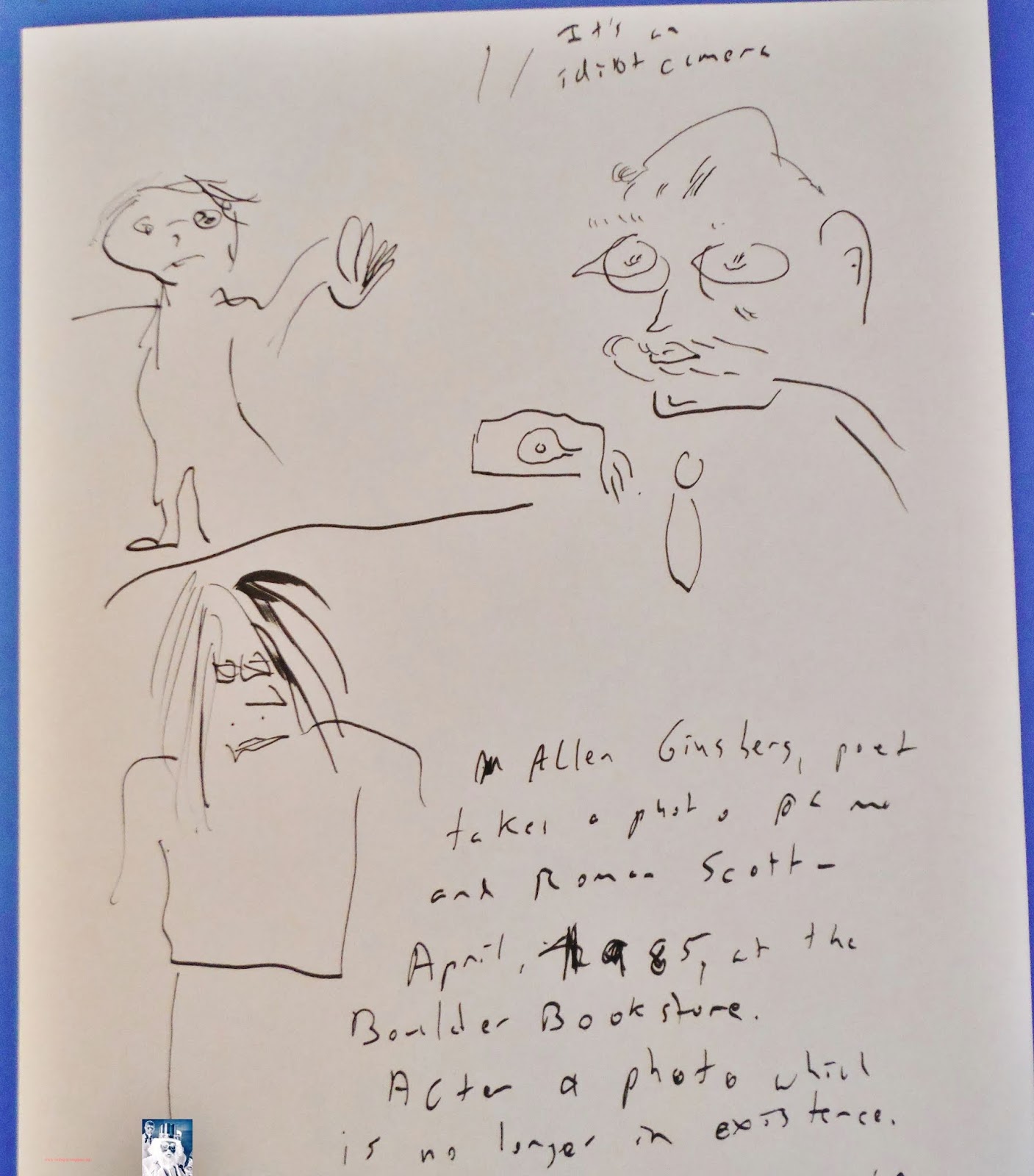
Sketch of Boulder Book Store, April 1985

Here's a study I did; based on my recollection of a photograph (or based on an amalgam of several photos) captured of Allen Ginsberg, by Roman Scott, April, 1985; at the Boulder Book Store, Colorado. We spent twenty or thirty minutes conversing with the poet... The series of photographs vanished, alas, as I have mentioned elsewhere. Ginsberg also snapped a couple pictures of me, Roman, and others who were there. I have examined the images from that period in the Allen Ginsberg collection, in the Stanford University Library digital archives  -- but if the photos survived that he took at the signing, I was not able to locate them (there are a couple sheets of Ginsberg photos from April 12th and 13th, 1985, in Boulder -- the same visit).

Sunday, January 8, 2017

Allen Ginsberg Dream Journal, 1988


A journal entry involving a dream about Henry Kissinger, from December 2, 1988, by Allen Ginsberg, from We magazine, issue 12, which appeared around 1990. Allen Ginsberg signed the page for me at Powell's Books in downtown Portland, August 30, 1991. Todd Mecklem and I also had a poem, Löwestrasse, in this issue.


Saturday, August 15, 2015

My Father's Time at Reed College, and Other Fragments

My father, International House, Yale University, New Haven, Connecticut, August 1986. Photo by JF.

 Daddy Domino, by Mildred Plew Merryman, illustrations by Janet Laura Scott. Published by the Buzza Company in 1929, the year the stock market crash triggered the Great Depression. The book was a Christmas gift to my father in 1934, according to an inscription inside. The book filled me with awe and unplaceable dread as a child, with its silhouette artwork and hypnagogic, late Art Nouveau feel, something from a time loop in either the film or book of The Shining.

My father sometimes obliquely referred to his session studying at Reed College, in Portland, Oregon. I was unclear exactly how long he attended Reed, or when he went there. The time he spent as a student at the college comprised one of the many fragments of his enigmatic existence. He conjured up an atmosphere including bohemian students and uncomfortably robust instruction.

It was only much later that I contacted Reed, and discovered that he failed to finish even the one semester he was at the college, in 1949. He potentially missed the drunken boat on this one, for this was the period of the Reed College Beats.


Thursday, September 26, 2013

And the Hippos were boiled in their Tanks


Months and years after I first gained awareness of William S. Burroughs' (http://realitystudio.org/ -- thanks to Ray of Rigadoon23 for making me aware of this website) and Jack Kerouac's (http://www.dharmabeat.com/kerouac.html) early collaborative novel, And the Hippos were boiled in their Tanks, I finally rolled over my eyes it.
I also am working over Junkie, or the edited version of it, re-reading this one.   Guys, couldn't you have tried a little harder with the Hippos cover?  Based on the covers of the two above, which book would you be drawn to?

And the Hippos were boiled in their Tanks reeled me in with its great frame of Kerouac's and Burroughs' fictionalized self-portraits, Mike Ryko and Will Dennison.  Any novel with the title, And the Hippos were boiled in their Tanks, and which uses the same phrase in its text, is already commendable.  (James Grauerholz's sterling afterword explores the possible sources of the Hippos title, along with discussing the Carr/Kammerer case which inspired the central events of the novel.) Rimbaud and "Phillip Tourian's" New Vision pepper the novel's trajectory to its ambiguous climax.  Some pages I lost track of which author wrote which chapter, a sign that Gysin's third mind here germinated.  Burroughs' writing, while not fully confident and crystallized, has a characteristically darkly dry and funny quality.  "Monday morning I got a letter from a detective agency to report to work.  I'd applied for the job about a month ago and almost forgotten about it.  Evidently they hadn't checked on my fingerprints and the fake references I'd given them."  Kerouac's melancholy descriptions of New York and picaresque accounts of merchant marine matters hold great appeal as well.  World War II, always over the horizon, influences the work in a lunar, tidal fashion.

Reading Junkie again, I was startled by its magnificence -- one great observation and character description following another.