About Me

My photo
Adalbert is a forum for me, to post ephemera, photography, poetry, occasional travel notes, and various spontaneous motions. Cover photo: Parsonage where my great-grandfather spent his early years. Taken near Liegnitz, Silesia, ca. 1870. The "xothique" portion of the web address is a nod to Clark Ashton Smith's fictional continent of Zothique.
Showing posts with label H.P. Lovecraft. Show all posts

Monday, March 16, 2026

Duane W. Rimel Story: A Bad Dream

 A story (or "theme"), A Bad Dream; by H.P. Lovecraft correspondent/collaborator Duane W. Rimel, published when he was a high school freshman; in the Asotin County Sentinel, 7 March, 1930. Via newspapers. com. 


Friday, November 15, 2024

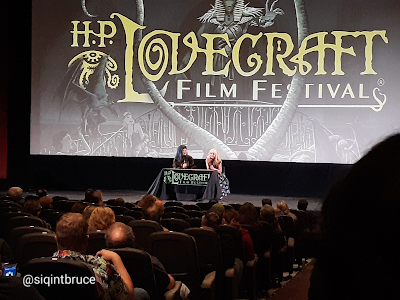
H.P. Lovecraft Film Festival, October 2024

 Here are a few photos I took, at the H.P. Lovecraft Film Festival and CthulhuCon (Portland), 2024. It's always refreshing to hear about the background of movies, both full-length and short. Among the short films that will linger with me: The Outsider, Terminal Emulator, Tranquilizer, and The Patron. 


Thursday, March 2, 2023

New Digital Works


Me, at Jim Morrison's grave, 2013.


                 Me, one year-old, watching a turned-off TV. -JF 

Saturday, January 28, 2023


 A micro-length tale I wrote last year. -JF 

Sunday, December 11, 2022

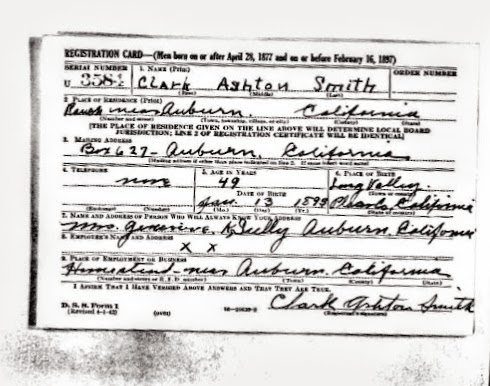
Draft Card Roundup; H.P. Lovecraft, Clark Ashton Smith, William S. Burroughs


WWI-era draft registration card for H.P. Lovecraft; and WWII-era cards for Clark Ashton Smith, and for William S. Burroughs. I extracted these, from Ancestry.com. 

Sunday, November 6, 2022

H.P. Lovecraft Film Festival and CthulhuCon 2022

 On October 8th and 9th, I shewed up (as I have many times, starting with the first one) at the H.P. Lovecraft Film Festival, at the Hollywood Theatre; staying for two full days. I took in Freeze, directed by Charlie Steeds, Short Blocks Three, Re-Animator, and Bride of Re-Animator (both followed by question-and-answer sessions, with Jeffrey Combs -- he made reference, to among other things, how Re-Animator originally took off through word-of-mouth, and then rentals). I also attended a showing of Night of the Comet (first time for me to viddy this hilarious, and atmospherically campy cult film), with Kelli Maroney appearing afterward (she provided great insights into the movie, mentioning for example that the sequences at the department store were filmed after hours, at the real deal). 

I also attended some panel discussions, on Lovecraft's Favorite Films, The Aquatic Origins of Weird and Cosmic Terror; along with one on comics, and one on video games. Sipping beer, then alternately removing a mask, I tossed the panels a couple questions, including one involving Fritz Lang's Die Nibelungen; and another with reference to Skull Comix. 

Gwen Callahan, with Kelli Maroney. 

Wednesday, March 9, 2022

More from the H.P. Lovecraft Annotated Bibliography


From the final version of my H.P. Lovecraft Annotated Bibliography, for Professor David Holloway's class at Portland State University; 1994.


Monday, January 24, 2022

From the Leaves of an H.P. Lovecraft Annotated Bibliography


A couple sample draft pages from an annotated H.P. Lovecraft bibliography; which I wrote in 1994 for Professor David Holloway's English 596 course, at Portland State University. 


Saturday, May 16, 2020

The Thing Who Goes There


Cover art by Hannes Bok; edition from Shasta Publishers, 1948.

Digital Collage by JF 


 I recently perused John W. Campbell's 1938 novella Who Goes There?, which has germinated three films to date (all of which I also watched/ rewatched lately). Campbell wrote the tale not long before the start of WWII in Europe; but the writing feels fresh as the thing in the ice itself (an earlier version, Frozen Hell, predated Who Goes There?). It has a few parallels to Lovecraft's short novel At the Mountains of Madness. These include the location in the Antarctic, and the uncovering of prehistoric and alien discoveries in the polar wastes (at the same time, there are great differences in development and atmosphere). 

Who Goes There? has a surgically minimal, yet poetic style. Campbell's characters frequently have outsized qualities. "Moving from the smoke-blued background, McReady was a figure from some forgotten myth, a looming, bronze statue that held life, and walked." In contrast with the careful assemblage of background and details in At the Mountains of Madness, the following line almost symbolized Campbell's approach: "There is no need for details."  The novel also has vague echos of the Antarctic destination in  Edgar Allan Poe's The Narrative of Arthur Gordon Pym; and its portentous albatross, feels like a harbinger out of Coleridge. Campbell's terse novella, with its replicated physical forms, and terrifying transformations, is a powerful read. (And the other stories in the collection are also superb.)


Thursday, April 16, 2020

Chthonic Survivals: Donald Wandrei's The Web of Easter Island

Cover art by Audrey Johnson

Donald Wandrei's The Web of Easter Island was a curious novel, with a story of cosmic terror and revelatory dread. The book was uneven. At times, moments of wondrous poetry and weirdness appeared:
"A fiery sun was setting in a coppery sky. The roofs of buildings and the tops of trees glowed with a dull flame." The passages which involved Easter Island, and "Carter E. Graham, curator of the Ludbury Museum of Archaeology and Anthropology" were initially promising.  Other parts contained awkward phrasing, and the work spun into episodes that unraveled, under the weight of overreach. The writing had a few more overtly racy passages than appear, for instance, in much of the writing of Wandrei's associate, and correspondent, H.P. Lovecraft: "The narrow areola around each nipple clung like the budding heart of a blood rose aganst the tan of her skin." (P. 55, TWEI). (Although one can counter that with this selection from a letter from H.P. Lovecraft to the singular poet and writer, Clark Ashton Smith: "I need not say how enormously grateful & delighted I am at receiving the MS. of 'Solution.' It is a haunting, fascinating thing, which makes the reader involuntarily look over his shoulder as if fearful of beholding long lethal visions of primordial ooze peopled with gnarled, sentient, & cyclopean trees that watch perpetually & wave black slimy branches in unholy orgasms." (From Dawnward Spire, Lonely Hill: The Letters of H.P. Lovecraft and Clark Ashton Smith, ed. by David E. Schulz and S.T. Joshi; Hippocampus Press, 2017).  (In 2011, Centipede Press issued an edition containing an earlier draft of the book, Dead Titans Waken!.) (Bobby Derie has written extensively on erotic elements in Lovecraft, and many other authors.)


Ultimately, The Web of Easter Island does not "correlate its contents" and conclude in a satisfactory way, in contrast with, for example, H.P. Lovecraft's masterful short story, The Call of Cthulhu (1926).


Saturday, March 14, 2020

Lovecraft at Last: The Master of Horror in his own Words


Lately I finally absorbed Lovecraft at Last (Cooper Square Press: 2002), by Willis Conover, decades after reading the other two Lovecraft-related books, also released in 1975 (Lovecraft: A Biography, by L. Sprague De Camp, and Howard Phillips Lovecraft: Dreamer on the Nightside, by Frank Belknap Long; as mentioned by S.T. Joshi, in his introduction). Conover's work, which he constructed brilliantly with letter excerpts, photos, and other visual material, and his own reflections, is a touching account of his friendship-from-afar, with H.P. Lovecraft.  Conover conveyed the tragic nature of the closing of their fleeting correspondence, in admirably understated ways, mostly letting the letters provide their own testimony. The book is a stellar achievement.
H.P. Lovecraft's friend and correspondent, Robert H. Barlow, famously had a link, as his teacher at Mexico City College, to novelist William S. BurroughsWillis Conover's life -- he became a prominent broadcaster, for the Voice of America, also had some unexpected outcomes.


Saturday, January 25, 2020

Trances of Twilight, & The Howler

Two stills from The Howler (with Roman Scott, wearing the beret, and me, below, encountering a wall); a Super 8 movie we made in 1987. The film originated with an H.P. Lovecraft poem, from his Fungi from Yuggoth sonnet cycle.

Sunday, November 3, 2019

Dual Weird/Horror HPL Events

Director Richard Stanley (with Brian Callahan), Q and A, after a showing of Color out of Space, closing night, H.P. Lovecraft Film Festival, 2019. The movie presented a contemporary take on HPL's masterpiece; remaining mostly faithful to the bleak cosmicism of the original (with pathos, and a bit of humor, and scenery-chewing, from Nicholas Cage).   During the question session afterward, I offered a question about the appearance, in the film, of a copy of Algernon Blackwood's The Willows. 

Robert Corman and Victoria Price, talking about Vincent Price, filmmaking, and other matters, after a showing of The Haunted Palace, at the 2019 H.P. Lovecraft Film Festival. I also saw Robert Corman (with Andrew Migliore) in a discussion after a showing of X: The Man with the X-Ray Eyes (the first time I'd seen the film; he revealed, among other things, that Don Rickles was nervous at first, since it was his first movie).

I also took in Shorts Blocks 1 & 3, & the audience-involved Dark Adventure Radio Theatre production of HPL's The Lurking Fear, among other events.


Cody Goodfellow, reading at the Lovecraft at the Lovecraft (Bar) event, 10-19-19 (he appeared, along with a number of other performers, writers, and poets). Also pictured: John Shirley (who fronted the Screaming Geezers, appearing as a sort of punk preacher of chaos, and Adam Bolivar, who put on a grimly compelling marionette show).

John Shirley and the Screaming Geezers


Sarah Walker reading at the Lovecraft Bar (with John Shirley, and Wendy Wagner watching on the right). Jason V. Brock, and Nathan Carson, also read.

A trip I recently took, to Colorado, Nebraska, and New York City (and running into some traces of past voyages/stays in those places), had for bookends these two H.P. Lovecraft-inspired festivals/events. 

Thursday, October 11, 2018

H.P. Lovecraft Film Festival and CthulhuCon 2018

l-r, Gwen Callahan, NECRONOMIDOL, Brian Callahan, Cthulhu Girl, 10-7-18


l-r, a spectral Andrew Migliore, the artist Skinner, Richard Stanley, Scott Connors, Darin Coelho Spring, Wilum Hopfrog Pugmire, panel discussing Clark Ashton Smith and the rapturous documentary on Smith, The Emperor of Dreams. 10-6-18.
Upstairs, at one section of the CthulhuCon.

I attended all three days of the 2018 H.P. Lovecraft Film Festival; joining a panaroma of HPL festivals I have attended, starting in 1996. There were a panel or two, and a reading I wish I had seen, but I was pleased with Short Film Blocks 1, 2, 3, and 4. Among other events and films, this year's standouts include the performance by Necronomidol, the world premier unveiling of The Emperor of Dreams, and the surprise showing of a subtle, disturbing version of The Shadow over Innsmouth, from the 1990s, by Chiaki Konaka (the question session, assisted by a translator, afterward included a reference to a Arnold Böcklin influence in the film!). Overall another great festival.  


Wednesday, April 11, 2018

Night Oceans


Cover art: Will Staehle for The Night Ocean: A Novel; Jason C. Eckhardt, for the Necrononomicon Press edition

Paul La Farge's The Night Ocean: A Novel, and Robert H. Barlow's and H.P. Lovecraft's The Night Ocean


Thursday, October 19, 2017

October Routine, at the H.P. Lovecraft Film Festival

On 8 October I experienced the day at the H.P. Lovecraft Film Festival and CthulhuCon in Portland, Oregon -- around the 14th time I've attended, off and on, starting with an early event in 1995 or so at the Fifth Avenue Cinemas.


 Q & A with participants in Lovecraft Under the Gun.


Tim Uren's extraordinary solo, dramatic interpretation of Lovecraft's The Rats in the Walls.

Photos by JF.

Saturday, February 18, 2017

Dunwich Horror Illustration by Roman Scott


A drawing (1977) by Roman Scott, depicting a scene in H.P. Lovecraft's story 'The Dunwich Horror.'

Wednesday, November 23, 2016

In the Mountains of Madness


A month or two ago I took in an advance review copy of In the Mountains of Madness, a biography/cultural study of H.P. Lovecraft. I also took a look at the work in its final form. I noted few differences between the two versions, other than a few spelling corrections. The book has a few good points; it's adequate as a basic account of Lovecraft's life. But Poole's study contains numerous flaws.

   The ideas and writing are frequently inane, derivative, or poorly-researched. With reference to the movement which succeeded in vanquishing Gahan Wilson's Lovecraft-figure trophy bust from the World Fantasy Convention awards, Poole writes: The petition further urged that the award, in a symbolic move, replace Lovecraft's head with that of Octavia Butler, an African American writer that any objective observer would describe as one of the greatest fantasy and horror writers of the twentieth century, one whose work in many respects exceeds the boundaries of genre.

   Come on now, the bar's set pretty low here. A fantasy and horror writer? A cursory web search reveals that Butler was a science fiction writer, not a "fantasy and horror writer." And just how is this assessment of her "objective?"

   Here's another questionable statement: "He (Lovecraft) did not call the suicide hotlines that did not exist in 1904." What is the reason for mentioning something so banal and obvious, in such a contorted manner? Other dubious segments of the book include a forced attempt to define Lovecraft as an earlier practitioner of gaming, and a strange statement concerning the possible future cult status of the prose poem "Nyarlathotep."

   In total, the book is a curious exercise, lacking in useful insights.


Sunday, October 16, 2016

H.P. Lovecraft Film Festival & CthulhuCon, October 2016


Stuart Gordon at a Q & A session following a screening of the unrated director's cut of From Beyond. One observation Gordon made was: Republican administrations are golden eras for horror (but don't get any ideas). Saturday's events also included a dynamic live radio show presentation by the H.P. Lovecraft Historical Society: Dagon:  War of Worlds, with splices from The Temple, Dagon, and The Shadow over Innsmouth. And I caught some other movies and short films.

Friday, September 23, 2016

Providence


And today back in Providence, RI, for the first time since August, 1986. Today I walked by H.P. Lovecraft's last home, and also visited his grave in Swan Point Cemetery.