A story (or "theme"), A Bad Dream; by H.P. Lovecraft correspondent/collaborator Duane W. Rimel, published when he was a high school freshman; in the Asotin County Sentinel, 7 March, 1930. Via newspapers. com.


A story (or "theme"), A Bad Dream; by H.P. Lovecraft correspondent/collaborator Duane W. Rimel, published when he was a high school freshman; in the Asotin County Sentinel, 7 March, 1930. Via newspapers. com.
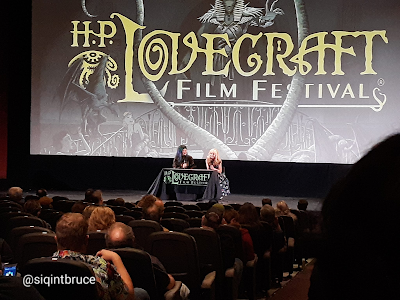
On October 8th and 9th, I shewed up (as I have many times, starting with the first one) at the H.P. Lovecraft Film Festival, at the Hollywood Theatre; staying for two full days. I took in Freeze, directed by Charlie Steeds, Short Blocks Three, Re-Animator, and Bride of Re-Animator (both followed by question-and-answer sessions, with Jeffrey Combs -- he made reference, to among other things, how Re-Animator originally took off through word-of-mouth, and then rentals). I also attended a showing of Night of the Comet (first time for me to viddy this hilarious, and atmospherically campy cult film), with Kelli Maroney appearing afterward (she provided great insights into the movie, mentioning for example that the sequences at the department store were filmed after hours, at the real deal).
I also attended some panel discussions, on Lovecraft's Favorite Films, The Aquatic Origins of Weird and Cosmic Terror; along with one on comics, and one on video games. Sipping beer, then alternately removing a mask, I tossed the panels a couple questions, including one involving Fritz Lang's Die Nibelungen; and another with reference to Skull Comix.


 |
Cover art by Audrey Johnson
Donald Wandrei's The Web of Easter Island was a curious novel, with a story of cosmic terror and revelatory dread. The book was uneven. At times, moments of wondrous poetry and weirdness appeared:
|
 |
Director Richard Stanley (with Brian Callahan), Q and A, after a showing of Color out of Space, closing night, H.P. Lovecraft Film Festival, 2019. The movie presented a contemporary take on HPL's masterpiece; remaining mostly faithful to the bleak cosmicism of the original (with pathos, and a bit of humor, and scenery-chewing, from Nicholas Cage). During the question session afterward, I offered a question about the appearance, in the film, of a copy of Algernon Blackwood's The Willows. |
 |
Robert Corman and Victoria Price, talking about Vincent Price, filmmaking, and other matters, after a showing of The Haunted Palace, at the 2019 H.P. Lovecraft Film Festival. I also saw Robert Corman (with Andrew Migliore) in a discussion after a showing of X: The Man with the X-Ray Eyes (the first time I'd seen the film; he revealed, among other things, that Don Rickles was nervous at first, since it was his first movie).I also took in Shorts Blocks 1 & 3, & the audience-involved Dark Adventure Radio Theatre production of HPL's The Lurking Fear, among other events. |

 |
John Shirley and the Screaming Geezers |


 | ||
| l-r, Gwen Callahan, NECRONOMIDOL, Brian Callahan, Cthulhu Girl, 10-7-18 |
 |
| l-r, a spectral Andrew Migliore, the artist Skinner, Richard Stanley, Scott Connors, Darin Coelho Spring, Wilum Hopfrog Pugmire, panel discussing Clark Ashton Smith and the rapturous documentary on Smith, The Emperor of Dreams. 10-6-18. |
 | |
Upstairs, at one section of the CthulhuCon.I attended all three days of the 2018 H.P. Lovecraft Film Festival; joining a panaroma of HPL festivals I have attended, starting in 1996. There were a panel or two, and a reading I wish I had seen, but I was pleased with Short Film Blocks 1, 2, 3, and 4. Among other events and films, this year's standouts include the performance by Necronomidol, the world premier unveiling of The Emperor of Dreams, and the surprise showing of a subtle, disturbing version of The Shadow over Innsmouth, from the 1990s, by Chiaki Konaka (the question session, assisted by a translator, afterward included a reference to a Arnold Böcklin influence in the film!). Overall another great festival. |


