About Me

My photo
Adalbert is a forum for me, to post ephemera, photography, poetry, occasional travel notes, and various spontaneous motions. Cover photo: Parsonage where my great-grandfather spent his early years. Taken near Liegnitz, Silesia, ca. 1870. The "xothique" portion of the web address is a nod to Clark Ashton Smith's fictional continent of Zothique.

Tuesday, March 6, 2012

Crazy as Usual


A postcard sent by my father to his father and family, with a hand-coloured photo of the Bonneville Salt Flats. To lend even more authenticity, a packet of SALT from Great Salt Lake, Utah, was sewn to the card by Apex Novelty, S.L. City. I'm surprised the packet stayed attached as it went through the mail system. Probably there was less mechanised processing in those days.

Text:
TERRIFIC SPEEDS SET -- ONE 230 MPH ONE WAY -- MOTORCYCLISTS RAN IN BATHING SUITS
CRAZY AS USUAL

Sent to G.R. Falk & Family
4046 Llewellyn
Milwaukie Oregon

The postmark is only partially imprinted, as they often are -- the year is plainly 1951, the month and date may be September 7, and the hour was 6pm. I can't quite decipher the town in the postmark -- could be Wendover, Utah.

"And now for something completely different," -- Bohica time, daylight saving time is nigh. Got to allow extra light for Abner to grow and harvest the barley.

Thursday, March 1, 2012

Making Tortillas, Queretaro, Mexico

Stereoscopic card shewing the process of tortilla making, in Queretaro, Mexico. Just taking a wild guess, I'd place the twin photos around 1900 or so. I was unfamiliar with the name so typed "Queretaro" into the Wikipedias. Here one can see (among other things) that the city and surrounding state are in Central Mexico, and the Treaty of Guadalupe Hidalgo (which ended the Mexican-American War) was signed in the city. I understand that treaty might have been a bit controversial at times.

Dream of Jimi Hendrix: I was watching a movie of him made around the time of Woodstock, with his figure projected looming in a dim old theatre. He had a pained, tragic cast to his face, and was forming mudra- like shapes over a guitar, drawing out wolf howl notes, not touching the strings, theremin style. Time seemed to flow backwards -- I then was in a bus approaching the theatre, before the film started.

Tuesday, February 28, 2012

Elmer's Tune


A folder I began doctoring in my freshman year of high school, I believe, and continued working on through high school and a year or two beyond. I no longer know what type the original folder was, but the delirious accretions reflected my interests. Snippets from Oddities, an animal bone, a plastic doll arm, photocopied images of Tristan Tzara, Marcel Duchamp, Andre Breton and other surrealist/ Dadaists, Rimbaud's face, one of Lovecraft's homes, a piece of a cigar package, a postcard depicting "Sylvester," a mummified man found in the Arizona desert, who was displayed in Ye Olde Curiosity Shop on the waterfront in Seattle, comic art by Richard Corben, R. Crumb, Gilbert Shelton, tiny reproductions of E.C. Comics covers, Lon Chaney as the Phantom of the Opera, a painting by William Holman Hunt called The Scapegoat, photos from old medical books, Tom Peterson's face (an icon from the 1960s through the 90s or so, Portland area retailer), and other images/objects, coated with hard layers of dried Elmer's glue. Incidentally, the familiar white stuff seems to be a pretty good preservative. I inexplicably painted the front cover black at some point, and then scraped as much of the pigment off as I could.
This folder, which transported notes and school work and documents, attracted notice and commentary from time to time. Other times, I used the standard "Pee Chee," or other folders. The Pee Chee folders, with their vibrant figures caught in sports activities, are still around, not changed much from the 60s or 70s. No doubt the tennis player and other athletes have racked up millions of alterations -- with drawn- on moustaches, afro hairstyles and the like -- over the years.

Thursday, February 23, 2012

Colourless Green Ideas Sleep in R'lyeh

Monday, February 20, 2012

Empty Wind/ Carthage


Empty Wind

Heavy roof, beams, green and blue-cored, beneath the eaves.
In low basins switch turtles, eels, and rock fish; bleached mouths of pig heads.
Moon and heights; river's channel, parting down a bed of settled stones, at bourn of pine and hills, summits crusted with grave markers.
Ends' of birds' wings, wind; covering over peak, misted and lit.
A water clock proceeded and toned over yard, a line of hewn rocks in white grass, scented and wood-slabbed hall.
Woven straw, twisting on the ground, boxed and trunk and branch in sober morning.
Swollen-topped stones, rain flicking torii's red columns, rock-slabbed entrance at base

Carthage

Revenant and clammy huelessness, tunic, composed face, topknot; submerged in desert dust at the four-cornered mount where took place the ceremony and procession -- balls, incense, palanquins, joss, somber and in movement. The withdrawal of the clay of feet. Above, in dim light.
Sunk and hollow, bled away, reclining, cask and body of gold-threaded jade plaques, nose insertions, and eye plates: the scavenger of the royal elements of the white stone circle or rise.
Gas and water houses and temples, slandered, gigantic in stucco facades and domes, on the unending plain of slopes, behind a brazen streak from the falling sun.

JF


"Empty Wind" and "Carthage," two prose poems by myself, published in
Pacific Coast Journal,
Volume II, Number ii, published by John S. French, French Bread Publications, of Campbell, California, Winter, 1994. 1994 would have been one of the last years in which a publication like this would have existed (more than likely) only in the world of print, with the editor accessible only by writing a p.o. box -- with no reference to websites or e-mail addresses. I couldn't find too much about the zine on the webs. As far as I can tell, Pacific Coast Journal seemed to finally enter the realm of spirits after 2009.

Dream: I was hiking amidst primordial trees, hollows, and mounded hills from the natural world of Hawthorne or Charles Brockden Brown. Mystery interlopers walked by somewhere below.

Monday, February 13, 2012

Alan Turing: The Enigma, and other biographies


I'm in the midst of reading the challenging biography Alan Turing: The Enigma, by Andrew Hodges, published in 1983. The tome unwinds the tale of Alan Turing, the British mathematician who was one of the pivotal figures in decrypting the Enigma machine system used by the German military for communicating in the 1939-45 War. The book has a good balance, explaining both the private world of Turing and the dramatic historical events in which he was caught. He had an epiphany involving what he called his "universal machine," which ultimately was partly responsible for leading to the development of computers. Turing took the insights he gained from his work with cryptanalysis and applied them as he programmed and helped design some of the very earliest successful computing machines (although he encountered many setbacks and frustrations in these efforts).

The Enigma is one of the longest and most detailed biographies I've read. Others I've read in somewhat recent years, in whole or in part, include Ian Kershaw's biography of Adolf Hitler (I've been working on that on and off for some time, and am currently bogged down in it like a halftrack in Archangelsk in winter), and S.T. Joshi's H.P. Lovecraft: A Life.
I still have a sentimental fondness for L. Sprague De Camp's Lovecraft: A Biography, which I purchased (and read more than once) in abridged, paperback form not long after the hardcover was released. Despite Joshi's (and others) savaging of De Camp's biograpy, L. Sprague does have a way of slashing through to cogent conclusions, as off the mark as he could sometimes be. (As with his misleading theories about Lovecraft's "poikilothermism" and "schizoid" tendences.)

Although I wouldn't press the point very far, the horror visionary and the dictator had at least one or two chance similarites -- their lifespans overlapped pretty closely, and they both had "lost," dropout periods at roughly the same time, in the early 1900s. Despite Joshi's and Kershaw's great scholarship and discoveries, they both are so detail-driven that they sometimes miss the night sky for the stars. Kershaw, even with his massive comprehensiveness, has a few peculiar gaps when discussing the Austrian street person and German chancellor. Curiously, there is almost no discussion in Hubris (at least that I've yet encountered) of the nature and subject matter of Hitler's watercolours and drawings, for example, not even the usual comment (whether accurate or not) about how bad they were.

What is it to be a "failed artist?" Is the art itself a failure, or did one fail at an artistic career? Or both?

Thursday, February 9, 2012

U.S. Battleship Indiana

Stereoscopic card of the U.S. Battleship Indiana from 1899. A search on the Googles indicates the ship was involved in the Battle of Santiago in the Spanish- American War.

Thursday, February 2, 2012

Wilhelm Furtwängler


Unsent postcard depicting German conductor and composer, Wilhelm Furtwängler (1886-1954), published in Stuttgart (apparently attached to a calendar?). I'd guess him to be in his 40s or early 50s at the time, which would put the photo (and card) in Weimar or Nazi- era Germany.
I wonder how he got the scars -- duelling? The Wikipedia article details his life, conducting, his somewhat shadowy relationship with the Third Reich, and includes the following amusing information:
"Furtwängler was famous for his exceptional inarticulacy. His pupil Sergiu Celibidache remembered that the best he could say was, 'Well, just listen' (to the music). Carl Brinitzer from the German BBC service tried to interview him, and thought he had an imbecile before him. A live recording of a rehearsal with a Stockholm orchestra documents hardly anything intelligible, only hums and mumbling."

Monday, January 30, 2012

Dreams in the Witch-House

A few hours ago watched Stuart Gordon's 2005 tv adaptation of H.P. Lovecraft's The Dreams in the Witch House ( I guess it sounds more contemporary if one drops the article). Kind of a mixed bag, and I feel the same ambivalence I feel about all of Gordon's HPL films (having also seen Re-Animator and From Beyond). The film has little to no atmosphere and leaves out most of the quantum mechanics and cosmic elements that infuse the source tale. Walter Gilman opening up a laptop? C'mon. The hilarious audience participation-encouraged, amateur version of Dreams I saw at the HPL film festival will probably stay with me longer. And the whirling sound accompanying the film is originating from Swan Point in Providence.

Sunday, January 29, 2012

The Elevated Railroad on the Bowery, New York


Stereoscopic card, from around the 1890s or early 20th Century.

Thursday, January 26, 2012

Winter


Winter

Wild blackness rolls in the skies. Its whorls are city coals, sheets of skeletal water shimmer in the harbor.
The feathers of winter, a harbinger tolling over the land, snapping fires feed morning twilight. Air seeps over my arms.
On the ridge of trees, birds settle, rasping of distant waters. Light rays and fills land heights, a drained reservoir, thorny leaves. The wind carries grey ashes, squash loads the lands, rippled grey roofs meet the sea, winter's coils sink against the star-flashing nightfall.

JF
Chinhae City, South Korea
1995

Monday, January 23, 2012

Dolmen in the Wood of the Small Port, Nantes, France


Unsent postcard from Nantes in Western France, depicting a neolithic dolmen or portal grave.

Friday, January 13, 2012

T.J. Masurian


Photo of my great-grandfather Ludwig Falk (cf. entry of September 10, 2010, and others) in old age, together with, from left to right, his wife, Margaret, grandson, his daughter (my great aunt), my maternal grandmother, and part of someone's side (my grandfather?). Ludwig looked pretty dapper there with the beard and suit. Probably taken in Milwaukie, Oregon, ca. 1924.
What model car is it? Whose car? Who was standing behind the camera at that moment?

Monday, January 9, 2012

petrol cedar Emily Carr sky


Hand-coloured stereoscopic card depicting a scene from the Russo-Japanese war period. I don't suppose "foraging" is anything like "looting."

Thursday, January 5, 2012

It is what it is

Thursday, December 29, 2011

251170

Saturday, December 24, 2011

Potentia Tilebacker

Sunday, December 18, 2011

Canopic


Canopic Fair

Spike to Spica:
The elder photons of constellations unassigned signal bovine reptiles

The Fisher King is dead, a vendor of smoky sausages said to us, the odor of Neanderthal sinus, brush on a distant plain.

Pig eyes are closest to human of any livestock,
roller pigeons shrug and cluck, turkey stomps and spins, rabbit haunch somnambulistic.

Mist and manure blur wyrd and Rosicrucian,
Roof vent combs the zephyrs of dusk.

JF 8-22-2011

The cynosure of the photo is President Bill Clinton, whose head you can just see to the right of the Matrix guy. June 1995, Portland State University campus.

Saturday, December 17, 2011

Orphan Blogs

When I first look at an unfamiliar blog, one of the first things I notice is the date of the most recent entry. I am bemused when the date of the final entry is from months, or years earlier, indicating that the author, or authors, stopped writing, posting, updating. Sometimes one just may not feel like continuing the blog, losing interest. One may be ill, dead, incapacitated, busy; Or one may have gone on to loftier summits (or moved operations to Daguerreotypebook or other websites).

There are innumerable examples, but here's one. This outstanding website: www.gustavhasford.com announces the start of a new blog devoted to author Gustav Hasford, posted by Hasford's cousin, Jason Aaron: www.gustavhasford.blogspot.com. The idea must have sounded good at the time, but the blog ends on July 18, 2008 (nine days before I began this one), fading off in a way nothing at all like Franz Schubert's Symphony 8 or Anton Bruckner's curse of the ninth. While the blog may not have endured, there is a lot of fantastic stuff on Jason's site, including the complete texts of The Short-Timers and The Phantom Blooper.

So one can study, for example, how a sequence about Mr. Payback torching rats in The Short-Timers, with a sardonic chorus from the Mickey Mouse Club Song, was translated into the symphony of flame that is the final scene of Full Metal Jacket. And I immediately have respect for someone (Hasford) who uses quotes from William S. Burroughs, Allen Ginsberg, Walt Whitman, and Henry David Thoreau as epigraphs in a Vietnam War novel.

Monday, December 12, 2011

Oneonta Gorge


Oneonta Gorge, Columbia River Gorge, Oregon. Photograph by Cross and Dimmitt. The overexposure produces a feel of the fugitive overlaying the stony certainties of the narrow gap. One wonders about cards that were never sent -- possibly someone intended to use this card and didn't, or just kept it as a souvenir.

Sunday, December 11, 2011

Some kind of a loosey goosey, Atlantean singing crystals startup


Selenite Fog


"The colour is of all the sunsets and sunrises of the earth combined"
Parallel to the sky runs a band of mist, unexpectedly,
The eclipse might be terminating up there now, totality, the earth projecting its tombs and precipices, dovetailed to the mare,
Can't see it like Gyeongju, didn't get the opportunity,
the places one has been are more important than the books one hasn't read.
Goose passage, wings of embers, honk in cloud road, what lies before and behind migratory pace,
I've seen a few eclipses panoramic before
One solar divers lunar in shaded blood
not a particularly cosmic glyptodon
My watchful feet shuffle around the building,

dawn and twilight pave the uncertain atmosphere.

JF 11 December, 2011

Monday, November 28, 2011

Horsetail Falls


Horsetail Falls, Columbia River Highway, Oregon. Another ectoplasmic time lapse postcard out of the camera of Cross and Dimmitt. Undated, probably from the 1920s.

Sunday, November 27, 2011

The Sorceror's Ship


In the not long ago I read The Sorceror's Ship by Hannes Bok (1914-64), a gift. I was previously familiar with Bok as an artist and illustrator, known for his fantastic and grotesque horror, science fiction, and fantasy drawings and paintings (here's one good selection of the many online: http://monsterbrains.blogspot.com/2011/08/hannes-bok.html) . Such images as his iconically expressive stippled illustration for a reprint of H.P. Lovecraft's story Pickman's Model come readily to mind when thinking of Bok. In fact, until quite recently I was unaware that "Hannes Bok" (which is a shortened, alternate spelling of "Johannes Bach") was merely the nom de plume for one Wayne Francis Woodard, a fact which can be rapidly gathered when looking up Bok on the internets. Anyhoo, Bok is worthy of attention for his writing as well as his art.

The foreword by Lin Carter contains some charming reminiscences of Bok, describing him holding forth in his apartment in New York City (although he sounds as if he might have been a bit irritating to have been around). Curiously Carter describes a plot element of the novel as involving "a demigod as a passenger and a weird magic jewel for cargo." The back of the edition I have (Ballantine Books: 1969 -- I guess the one and only edition) contains the following quote from John W. Campbell: "....with a demigod as a passenger, and an enchanted jewel as cargo!" A basic rule for plagiarists: Don't borrow from another author whose words are printed on the same volume as yours. I'm assuming Campbell wrote his description first. The fantasy was first published in Campbell's magazine Unknown in December, 1942, according to Wikipedia.

The Sorceror's Ship is a nice, ethereal story with a classic "cold open" with a disoriented main character trying to figure out where the hell he is and what is happening. Bok's prose has hints of Dunsany's and Clark Ashton Smith's (and others') styles. The necromantic horrors toward the end are particularly reminiscent of Klarkash-ton's work. No doubt the plot, involving, among other things, a conflict between two rival islands, Athens-like Nanich and Spartan Koph, has some echoes of the geopolitical situation of the early 1940s.

The copy of Ship I have has a lacuna, missing pages 147-178, and has a double printing of the last pages, 179-205. It's not impossible to deduce what happens in the absent section, though.

Hannes Bok name generator: "Wolfgang Amadaeus Mozart" = "Wolfam Moz"
"Johannes Brahms" = "Hannes Bram"
"Ludwig Van Beethoven" = "Wigvan Bat"

Cover art by Ray Cruz.

Sunday, November 20, 2011

Billy Beer which Carter Quarters


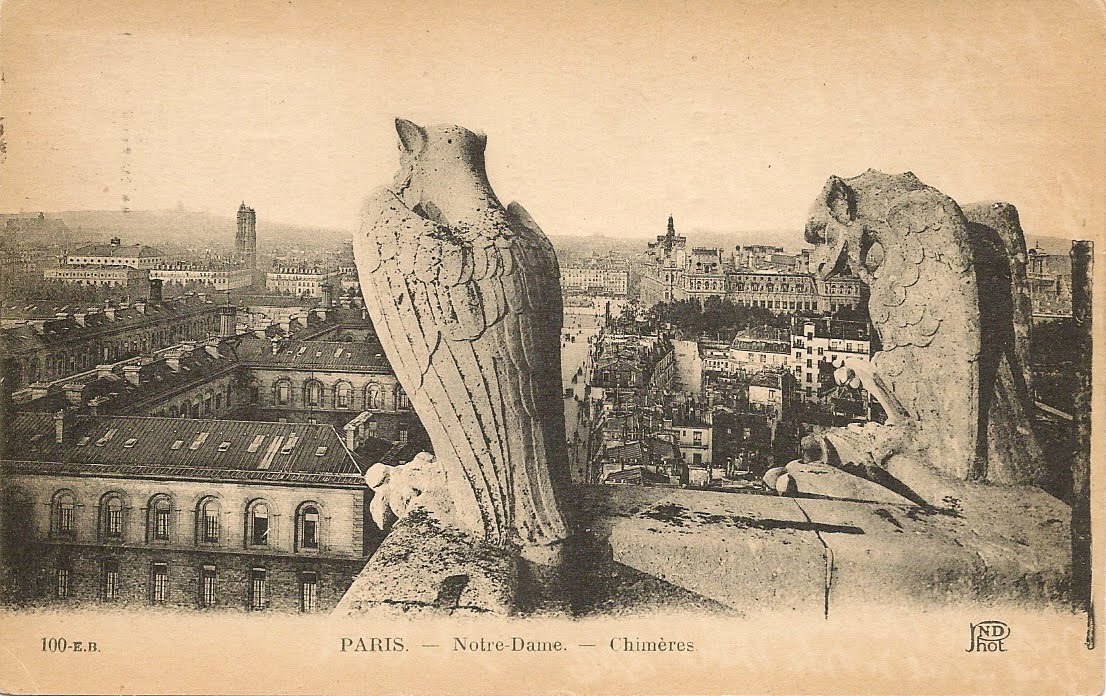
Paris

Here are a couple of the Gargoyles which overlook the Notre Dame. It is a wonderful church. Leave Tuesday for a trip thru the battle fields and old Hindenburgs head quarters We sail for NY or America (?) 215.00 Thurs (?) 5/29 Best (no signature)

Addressed to Albert N Combs, RR1- Lake Road, Milwaukie, Oregon USA

The reference to the battlefields and old Hindenburg date the card to not too long after World War One, of course, although I can't quite make out what the year might be from the postmark or handwriting. 1925?

Saturday, November 19, 2011

Sphinx Decoration/Memorial Day 1912


May 30th 1912
Dear Judge
On this day of memory. I will issue you your 10% interest in property, the picture of which you will find on other side. John Mc L

Addressed to Judge W.R. Biddle
Ft. Scott Kans

Saturday, November 12, 2011

Back cover of Wood


While in the past I was a devoted reader of various comics, with special interest in undergrounds and horror comics such as the 70s DC titles Weird War, House of Mystery, and Swamp Thing, I haven't been as attuned to more recent developments in the field. Of late (outside of following the work of one or two people I know who are active artists, comics and otherwise) my main reading has been of the standard one to eight panels or so newspaper comics. Stephan Pastis' Pearls before Swine is a standout, as is Darby Conley's Get Fuzzy. Conley has his own weirdly intelligent type of references, as when he recently had a strip which assumes knowledge of Goya.
In another, one of the talking animals who doesn't quite get it (Satchel the dog, I think) confuses Eugene Onegin with the phone book for Eugene, Oregon.

Dilbert is always reassuringly and wickedly cynical. And Charles Schulz remains the Christopher Marlowe Earl of Oxford William Shakespeare of the funnies -- I say, keep running them.

Trudeau seems to be spinning his wheels to some extent with his seasoned strip Doonesbury. His serial tends to be reactive, responding to the events of the day. This can cause a slightly unsettling phase delay, due to the lag in publishing. Paul Sorvino croaking as Kissinger in Oliver Stone's Nixon: Ve are playing a totally reactive game here. The Iraqistan (actually, mostly Afghanistan now) stuff seems to strain a little too much to be relevant. The cartoonist appears to think that merely mentioning high tech stuff is making some sort of point in itself -- as if merely showing someone tweeting on a smartphone is good enough. Pastis, in contrast, if he references contemporary communications, has a reason for so doing, as when he self-deprecatingly presents himself being savaged by bloggers.

Saturday, November 5, 2011

Thursday, November 3, 2011

Yugoslavia ain't no more


Friday, October 28, 2011

Thursday, October 27, 2011

The Cover of Wood, 1988

Thursday, October 20, 2011

The Child is father of the Man


Some students (and the teacher) from my first grade class at what was then known as Boring Grade School in Boring, Oregon (now known as Naas Elementary, after the principal of the same era -- he died shortly after he retired from the school). The class photo resurfaced recently -- in fact, I had no memory of it existing. To answer the obvious question: Sometimes the school was boring, sometimes exhilarating; And there is much about it I can't recall at all. Putting names beneath the class pictures was seemingly beyond the technology of the day. Who were these wild children? Myself in the large-striped shirt. I can link some faces to names, with some I recall the faces but not the handle, others leave no trace at all in my mind. Who's the sharp-looking dude in the checked sport coat? I ran across the obituary of the guy in the upper right corner in a local paper a year or two ago -- as H.P. Lovecraft put it in one of his letters (with reference to the then just-deceased President Warren G. Harding), he had the good luck to shuffle off this beastly planet. At least, that's one way to put it. One guy who appears here -- I have a vague dreamlike impression from when I was riding the bus home, of hearing some older kids discussing either him or his older brother having hanged himself (or maybe both of them committing suicide), as we passed his home set back in old trees. That event would have been a few years after this photo was taken. I apologize if I am misstating the facts or prematurely reporting someone's death -- the sequence seems like a wraith from interplanetary spaces. The Latino (or Native American?)- looking girl with the long dark hair-- I remember trying to impress her with the following story. When I was three or four, I inexplicably put my fingers in the open gap of a door by the hinges, and a relative unknowingly closed the door, catching the pinky, I think. Not recommended -- hurts like a sumbitch, although the bone wasn't broken, as far as I know. As if that story isn't good enough, I embellished it a little, claiming the bone had been extracted and replaced with an artificial bone after the accident (or something to that effect). Throw strangers together in a room and sequence them through decades, and all sorts of things may happen.

Sunday, October 16, 2011

brosnað enta geweorc


Friday, October 14, 2011

Wednesday, October 12, 2011

Winter Brothers


I finished not long ago Ivan Doig's Winter Brothers: A Season at the Edge of America, published in 1980. The work is an overview of, and thoughts about, the voluminous diaries of James G. Swan; who was a pioneer (among Euroamericans at least) in exploring and understanding the coastal areas of Washington State-- particularly the Olympic Peninsula: Port Townsend, and Neah Bay (as well as British Columbia and other places). I first cursorily read parts of the book (lent by a former friend) on a trip to the Olympic Peninsula many years back with a friend, which included a stop in Neah Bay and other places referenced in Doig's tome (along with a couple hours spend in Kurt Cobain-pre fame era Aberdeen, sauntering downtown, and visiting a thrift store). In fact, the trip was partly inspired by Winter Brothers, sort of following "on the trail of Swan." (I think of the volume sometimes as Swann's Way, simply because of the association with James G. Swan -- although it has nothing to do with Proust.)

It's an outstanding, but flawed, book. Consider the gripping tension of Swan's last adventure, to Haida Gwaii, the Queen Charlotte Islands (although the passage of the islands' West Coast is strangely understated, anticlimactic, not really delineated at all), and the sly, humorous, sometimes terrifying accounts of the frontiersman's life with the Makah and Haida, and other First Nation tribes. Much of this is in Swan's own words, but Doig's commentary helps link and explain the material. Against this, you also have the sometimes banal nature of Doig's thoughts: "I was surprised myself, far back along the highway when arriving to the cabin, how the lift of the mountain (Rainier) made itself felt even there, the road suddenly jerking into rising curves." Yeah, the ground does rise WHEN YOU APPROACH A MOUNTAIN.


Or: "(Even what I have been calling the Pacific Northwest is multiple. A basic division begins at the Columbia River; south of it, in Oregon, they have been the sounder citizens, we in Washington the sharper strivers. Transport fifty from each state as a colony on Mars and by nightfall the Oregonians will put up a school and a city hall, the Washingtonians will establish a bank and a union.)" Huh? That's just a tad condescending... Doig's whimsy on how a cat might end up getting smothered in bird poop is another idea that doesn't really fly.

The book overall is a good presentation of Swan's diaries, which could have benefited from tighter editing -- in fact, the whole framework of Doig's own commentary could have been either scrapped or seriously overhauled, with benefit. There are important themes covered in Brothers, such as the notion of traveling west, to "light out for the territory," until you can't go any further.
Doig's own writing only loosely (if at all) relates to Swan's journals and times.

Perhaps a biograpy, or selection of Swan's diaries, would be in order. And how I'd like to drop by Haida Gwaii.

I've also started processing Thomas "famously reclusive" Pynchon's V. -- so far, doesn't really grip me, but I will withhold judgement for now.